
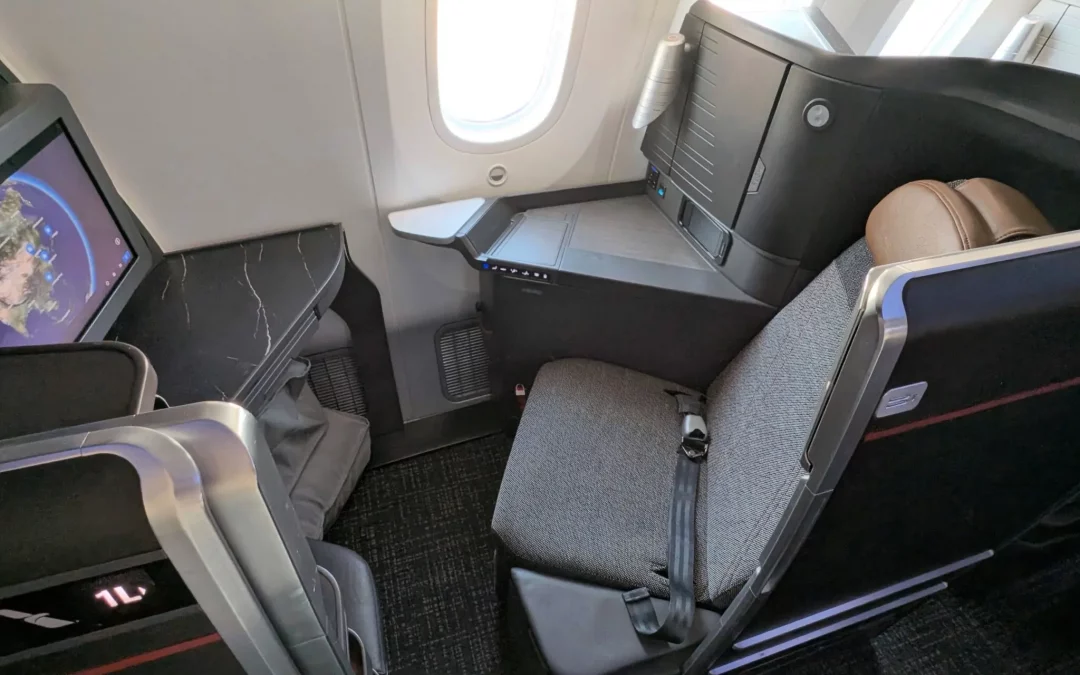

Flying American Airlines Flagship Suite: An Honest Review of the Seat That Could Change Everything for US Business Class
Nine hours from Dallas to London. A sliding door. A flat bed. Gate-to-gate wifi. Is this finally the business class product that puts American Airlines back in the conversation with the world’s best?
Let’s Be Honest About American Airlines for a Moment
If you spend any meaningful time in the world of business travel — if you read the forums, follow the aviation bloggers, compare products the way some people compare cars — you will know that American Airlines has had a complicated decade in its premium cabin. Polite conversations about AA’s long-haul business class tend to follow a predictable shape: someone mentions the lie-flat bed, someone else mentions the meal service, and then there is a pause, and someone usually says something like “well, it’s fine, but it’s not exactly Qatar, is it.”
No. It was not. For years, it absolutely was not.
American Airlines is the world’s largest airline by fleet size. It flies more people to more places than any other carrier on the planet. Its network is vast, its domestic reach unparalleled, its AAdvantage loyalty programme one of the most subscribed in global aviation. And yet, for a sustained and rather painful stretch of its recent history, its long-haul business class product sat somewhere in the middle of the global pack at best — serviceable, reliable enough, but lacking the design ambition, the privacy, and the sense of intentional luxury that the world’s leading carriers had been delivering since at least 2017.
The reasons were understandable if not entirely forgivable. A major bankruptcy and a transformative merger with US Airways consumed the airline’s management bandwidth and financial capital for years. Integration, debt reduction, and basic operational stability took precedence over the premium product investment that the market increasingly demanded. Other airlines — Qatar, Singapore, Cathay, Emirates, Japan Airlines — kept raising the bar while American stood more or less still. The gap became visible. And then it became uncomfortable. And then it started costing the airline corporate travel contracts.
The Flagship Suite is American Airlines’ reckoning with all of that history. It is the product the airline should perhaps have built five years earlier, but better late than never — because what it has built, rolling out across its Boeing 787-9 Dreamliner fleet on routes including the Dallas Fort Worth to London Heathrow corridor, is genuinely good. In some respects, category-leading. In others, still a work in progress.
Here is the full story.
What Exactly Is the Flagship Suite?
Before getting into the experience itself, it is worth being precise about what American’s Flagship Suite actually is, because the naming has caused some confusion among passengers familiar with the airline’s previous product portfolio.
American has used the “Flagship” branding for several years across its premium cabin products — the Flagship Lounge, the Flagship check-in, the Flagship dining experience — as a kind of umbrella identity for its top-tier international travel proposition. The Flagship Suite, however, refers specifically to the new generation of business class seat being rolled out on its long-haul aircraft. It is a fully enclosed suite with a sliding door, built on the Adient Ascent seat platform, and it represents a clean break from the previous Flagship Business seating that it replaces.
The specs: 21 inches wide, 79 inches long as a fully flat bed, configured in a 1-2-1 layout across two forward cabins totalling 51 suites on the 787-9. Direct aisle access for every passenger. A sliding door that closes completely for privacy. A 17-inch inflight entertainment touchscreen. Bang & Olufsen noise-cancelling headphones. Gate-to-gate high-speed wifi.
Those specifications, on paper, put the Flagship Suite firmly in the top tier of what is currently available in long-haul business class. The 1-2-1 layout — essential for ensuring every passenger has aisle access without the social negotiation of a staggered 1-2-1 or herringbone configuration — has been the gold standard of business class seating architecture for years. The sliding door is the detail that most clearly signals AA’s intentions: it says, in physical, functional terms, that American understands privacy is now table stakes rather than a differentiator, and that it has finally decided to deliver it.
The question that a specification sheet cannot answer is: what is it actually like to sit in one for nine hours on an overnight transatlantic flight?
Miami and Dallas: The Journey Before the Journey
This particular review route began in Miami — or, more precisely, it began with the friction that Miami introduced before the flight itself had even started.
American operates a dedicated Flagship check-in facility at Miami International, positioned as a premium-lane alternative to the standard business class priority queue. The concept is sound and the facility itself is well-designed: quieter, more spacious, with a calmer energy that signals to the arriving passenger that they are somewhere designed for their particular experience rather than simply processed through a generic system.
What undermined the concept, on this occasion, was a policy decision that the facility’s agents were unable to override. Despite arriving with a confirmed Flagship Suite ticket for the Dallas-to-London transatlantic leg, the check-in experience began not at the Flagship desk but in the regular priority lane. The explanation: the Flagship Suite service was departing from DFW, not MIA, and the facility’s access criteria were tied to the departure point of the Flagship-designated sector, not the origin of the booking. On paper, this may be internally consistent logic. In practice, it is the kind of bureaucratic fine print that erodes premium goodwill before the experience has properly begun.
The wait that followed ran to over forty minutes — an outcome that would have been unacceptable in any premium context, but is particularly jarring when you are holding a ticket that costs, for a return journey, somewhere in the region of eleven thousand US dollars.
The positioning flight from Miami to Dallas Fort Worth was operated on one of American’s older Boeing 777-300ER aircraft, still fitted with the previous-generation business class cabin — the product that the Flagship Suite exists to replace. It was a coincidentally instructive experience. The older cabin is not terrible. The seats are reasonably wide, the service is the same professional American standard that the crew will carry forward to the new product, and the journey time is short enough that the absence of a flat bed is merely notable rather than consequential. But the difference in material quality — the slightly scuffed armrests, the entertainment system that feels one software generation behind, the absence of any real sense of enclosure — was vivid against the knowledge of what was waiting on the next aircraft.
Dallas Fort Worth itself delivered significantly better. American’s Flagship Lounge at DFW is one of the better airport lounges in the US network — generous in scale, well stocked, with shower facilities and private seating areas that make the pre-departure hours genuinely restorative rather than merely endurable. A glass of Bollinger Champagne on arrival set a very different tone to what Miami had offered. The lounge was busy — quite significantly so, on the evening in question — and the crowd pushed the noise levels higher than a premium environment ideally accommodates. But the underlying quality of the space is real, and with a little more seat turnover it would be close to excellent.
Boarding: When a New Aircraft Announces Itself
The boarding process at DFW ran slightly behind schedule, a minor delay that matters less in the moment than the experience awaiting at the top of the jetway.
There is a quality that brand-new aircraft have — a smell, a stillness, a particular quality of light on surfaces that have not yet been touched by enough hands to lose their newness — that is difficult to describe with precision but impossible to miss. American’s new 787-9 Dreamliner has it in abundance. Stepping into the forward cabin for the first time produces a sensation that is almost physically different from boarding any aircraft you have boarded before: the quiet, the fresh materials, the sense of a machine that has not yet begun to accumulate the patina of heavy use. Whatever preceded this moment in the terminal, this is where the premium experience begins in earnest.
The Flagship Suite cabin, spread across two forward sections of the aircraft, presents itself well. The 1-2-1 layout is clean and confident — an aisle on each side, suites staggered in the way that the platform design requires to achieve the footwell configuration that allows full-length flat beds, but not so aggressively staggered that the rhythm of the cabin feels disjointed. The materials are muted and elegant: dark grey predominates, with warm tan accents on the upholstery and wood-effect trim on the suite surfaces. It is not a flashy design language, and that restraint is correct. The cabin looks like a place for serious, comfortable work and rest rather than a photoshoot location for an airline’s marketing department.
The suites themselves are, by any reasonable standard, spacious. The 21-inch seat width translates into meaningful comfort even for larger passengers, and the careful positioning of the armrests and the side wall means you are not spending the flight subtly fighting your own seat for elbow room. The storage architecture — personal space for a laptop, a phone, a book, a water bottle and the accumulated small items of a long flight — is better thought through than most, with each element placed where the logic of actual use suggests it belongs rather than where it was easiest to engineer.
And then there is the door.
The Door: Privacy, Finally
The sliding door on the Flagship Suite is, in the context of American Airlines’ recent history, something of a milestone. For years, the absence of meaningful privacy was the single most frequently cited criticism of AA’s long-haul business class product. The previous cabin was open — functionally open, visibly open, acoustically open. You were aware of your neighbours in the way that you are aware of strangers in an open-plan office: not intrusively so, but constantly. The sense of genuine personal space that the world’s leading enclosed suites deliver was simply absent.
The sliding door closes that gap. When it is shut — and it closes with the satisfying, well-engineered click of something that has been built to last rather than to impress in a showroom — the suite becomes a room. Not a hotel room, and not a room with natural light or the ability to stand up, but a room nonetheless: a defined personal space with a physical boundary between it and the world outside, a boundary that you control. The effect on the experience is immediate and real. The cabin noise recedes. The peripheral movement of crew and other passengers disappears. The psychological shift from “I am in a public space” to “I am in my own space” happens, genuinely and completely, in a way that the previous American product never managed.
The door also functions as a meaningful sleep aid. The light management in the Flagship Suite is thoughtfully calibrated — the ambient lighting moves through the appropriate transitions during the flight — but when other passengers have their reading lights on and the cabin is in that in-between state that long overnight flights pass through, the door contains all of that ambient light within the suite of its origin rather than distributing it across the cabin. The passenger who wants darkness gets darkness. The passenger who wants to read at midnight can do so without guilt. Both needs are served.
For the business traveller on a working flight — one of those increasingly common transatlantic crossings where the aircraft is functionally an extension of the office — the door also provides the acoustic semi-privacy that makes a phone or video call feel viable rather than socially impossible. It is not soundproofed in any serious sense, but it creates enough of a buffer that a quiet conversation does not feel like a performance for the surrounding cabin.
Entertainment and Connectivity: The Headline Act
American Airlines has made a clear strategic bet with the Flagship Suite, and the bet is this: that connectivity — genuinely excellent, gate-to-gate, high-speed wifi — is the premium feature that the modern business traveller values most, and that delivering it better than the competition is worth more than a few extra inches of entertainment screen.
That bet is correct. And on the Dallas-to-London service, it pays off completely.
The wifi on this flight worked. Not merely functionally, not merely adequately, but genuinely well. Gate-to-gate, without interruption, at speeds that made the qualifier “inflight” feel irrelevant. Streaming video on a personal device was smooth and uninterrupted. A video call — conducted for about twenty minutes in the early hours of the flight, before the cabin settled into sleep — was stable and clear. A document shared via cloud storage updated in real time. Watching a live sports broadcast while simultaneously checking emails while simultaneously monitoring the flight path on the inflight map: all of it worked, simultaneously, without any of the three applications pulling against the others.
For a nine-hour flight, the ability to use the first two or three hours productively before sleeping — to send the emails that needed sending, review the document that needed reviewing, update the presentation that would be opened at a meeting in London later that morning — is not a small thing. It is the difference between landing ready and landing behind. American’s wifi infrastructure delivers that difference more reliably than almost anything else currently available on a transatlantic service.
The inflight entertainment system is anchored by a 17-inch touchscreen — responsive, intuitive, and straightforward to navigate, with a content library that covers the major studios and a solid selection of international programming appropriate for a multicultural transatlantic passenger mix. The 17-inch screen size is the one area where the Flagship Suite concedes ground to its nearest competitors: several rival carriers now offer screens of 24 inches or larger, and the visual difference between 17 and 24 inches over a nine-hour flight is not trivial. On a competitor’s aircraft with a large entertainment screen and poor wifi, the screen size is the main event. On the Flagship Suite, with its exceptional connectivity, it is more of a supporting player — and on balance, given the choice between a larger screen and better internet, the connectivity wins. But the trade-off is visible.
The Bang & Olufsen noise-cancelling headphones are excellent. They are among the better supplied headphones in business class aviation, with a fit, a seal, and a noise cancellation profile that works on aircraft cabin noise specifically rather than requiring adjustment from a general consumer setting. Paired with the entertainment system’s audio output, they deliver music and film dialogue with a clarity that most inflight audio setups do not approach.
The Bed: Five Hours of Actual Sleep
Here is the simplest and most important thing to say about the Flagship Suite’s sleep experience: after five hours at 35,000 feet, somewhere over the dark Atlantic, waking up feeling genuinely rested is not something that happens by accident.
The bed configuration — 21 inches wide, 79 inches long, fully flat — is comfortable. The mattress surface is firm in the way that is actually preferable for extended sleep rather than the initial softness that feels good in a showroom, and the Flagship Suite allows sleep in multiple positions: on the back, on the side, in the various partial-recline configurations that a nine-hour overnight flight actually demands, because nobody sleeps flat on their back for nine hours unless they are unusually disciplined. The suite’s structural design accommodates position changes without the passenger needing to relocate to the centre of the mattress to avoid the suite’s walls or consoles. You can sleep, and stay asleep, in the way that your body actually wants rather than the way the seat specification implies.
The bedding — a pillow, a lightweight duvet-style blanket, and an additional cover — is adequate. A mattress pad has since been added to the Flagship Suite’s bedding package, though it was not present on this particular flight: the crew confirmed it was a recent addition to the product and that its availability on individual flights was still being rolled out. The pad’s absence was noticed, and its presence would have elevated the sleep surface noticeably. It is on the right list of improvements.
What the Flagship Suite does not yet offer is turndown service — the practice, standard among the leading premium cabin products, of having a crew member prepare the bed properly during the meal service so that the passenger can move directly from dinner to sleep without the intermediate housekeeping step. It is a small thing, and its absence does not prevent sleep. But it is the kind of detail that separates a good premium experience from a great one, and its absence is felt.
The sense of enclosure that the sliding door provides is, as a sleep enabler, significant. Darkness in the Flagship Suite is genuine darkness — not “relatively dim” or “dark enough if you don’t look toward the galley.” The combination of the closed door, the adjustable ambient lighting within the suite, and the noise-cancelling headphones creates a sleep environment that is meaningfully better than open-cabin business class, and meaningfully better than the previous American product. Waking up refreshed after five hours on an overnight transatlantic flight is not guaranteed by the seat alone, but the Flagship Suite gives it the best chance it has had on an American aircraft in a very long time.
Food and Drink: Ambition Meets Execution, Unevenly
The food and beverage experience on the Dallas-to-London Flagship Suite service is the aspect of the product that most clearly reveals both its ambitions and its growing edges. There are moments of genuine quality. There are also moments that remind you the catering programme is still catching up with the confidence of the hardware.
Opening drinks were strong. A glass of Black Stallion pinot noir — a Californian producer whose presence on AA’s wine list is a statement of intent in itself — was served chilled, in a proper wine glass, alongside San Pellegrino water. American’s wine list has genuinely improved, with a greater emphasis on American regional producers and a more considered curation approach than the previous “adequate and uninspiring” baseline. The Bollinger Champagne in the DFW lounge and the California pinot at 35,000 feet are both signals that someone with a proper palate is making beverage decisions.
The main dinner service is where things became instructive. Having neglected to pre-select a meal — an important note for all prospective Flagship Suite passengers: American’s long-haul catering requires advance meal selection, a step that the booking process does not make sufficiently prominent — the options available by the time the cart reached the rear of the cabin had narrowed to one: seafood, which an allergy rendered impractical.
The crew’s handling of this situation deserves its own paragraph. Rather than presenting a sympathetic shrug and a bread roll, the lead flight attendant assembled an alternative: lamb, with roasted turnips, peas and baby carrots in a fresh herb reduction sauce. It was put together with genuine professionalism, served without fuss, and delivered with the kind of warm composure that is the human face of excellent service. The lamb itself was overcooked and the portion was modest, but the vegetables were fresh and the reduction had real depth. The crew had done more than their job required, and it showed.
Dessert recovered the evening smartly. American’s signature sundae cart is a genuinely loved feature among frequent Flagship travellers — there is something charmingly theatrical about a dessert trolley appearing at an aircraft seat — and the centennial pecan tart on the dessert menu was a good choice alongside it. Opting for the cheese plate instead produced a satisfying final note: well-chosen selections at appropriate temperatures, properly accompanied.
Breakfast, served as the flight descended toward Heathrow in the grey London morning, was the meal that most impressed. A roasted-vegetable frittata with sun-dried tomatoes, wedge potatoes finished with a white cheddar cheese sauce, fresh fruit, and a warm biscuit served with butter and Bonne Maman strawberry conserve. It was a genuinely good meal — not “good for 35,000 feet,” but good in the fuller sense: thought-through, properly seasoned, made from ingredients that tasted like themselves. Accompanied by a strong cup of coffee served at the correct temperature, it was the kind of breakfast that changes the feel of an arrival.
Service across the entire flight was attentive, warm, and appropriately calibrated: present when needed, invisible when not. The crew clearly understood that a nine-hour overnight flight calls for a different service rhythm than a daytime sector, and they applied that understanding consistently.
The Verdict: A Product That Has Finally Found Its Confidence
The word that comes to mind, sitting back on arrival at Heathrow after nine hours aboard the Flagship Suite, is confidence. Not perfection — the pre-departure experience has its friction points, the catering has its inconsistencies, the amenity kit trails the best in the category, and the absence of turndown service and a mattress pad is noted. But the overall product has a sense of considered direction, of knowing what it is and delivering on that identity with conviction, that American Airlines’ premium cabin has not reliably displayed for several years.
The seat is excellent. The privacy is real and fully delivered by the sliding door. The connectivity is, without reservation, a category leader on the transatlantic route. The sleep experience works. The crew are some of the best in US aviation, and on this service they demonstrated both the training and the personal engagement that elevates a transaction into an experience.
Best for: Business travellers who prize connectivity and genuine suite privacy above all else, and who are routing through Dallas Fort Worth to European destinations. Those able to secure a bulkhead window suite — the A or K positions in the first few rows — will find the product at its very best.
A note on price: Return Flagship Suite fares on the Dallas to London route start at around USD $11,000. That is a significant commitment. At that price, the product needs to deliver — and on the seat, the bed, and the wifi, it does. The pre-departure experience and the catering programme need to follow.
Facts at a Glance
- Route: Dallas Fort Worth (DFW) → London Heathrow (LHR)
- Aircraft: Boeing 787-9 Dreamliner
- Cabin: Flagship Suite (Business Class)
- Configuration: 1-2-1 across two forward cabins
- Seat width: 21 inches
- Bed length: 79 inches
- Total suites: 51
- Flight time: 9 hours
- Inflight wifi: Gate-to-gate, high speed
- Entertainment: 17-inch touchscreen + Bang & Olufsen noise-cancelling headphones
- Return fares from: ~USD $11,000
Who Should Fly It — and Who Should Wait
The Flagship Suite is not the right product for every business class passenger, and it is worth being honest about that.
If you are a traveller for whom the dining experience is the primary premium differentiator — if your business class flight is incomplete without a multi-course meal of genuine fine-dining standard — the Flagship Suite is not yet at the summit. Qatar Airways, Singapore Airlines, and Japan Airlines all deliver a more polished and consistent catering experience. The gap is closing, and American’s breakfast on this service showed what the programme can achieve. But it is not closed.
If you are someone who uses every hour of a long-haul flight productively and for whom reliable, fast inflight connectivity is the single most valuable premium feature — if the ability to arrive in London having sent the emails, reviewed the deck, and made the calls matters more than any other individual element of the journey — the Flagship Suite on the 787-9 is the transatlantic product to choose. It is the best wifi in the sky on this routing, and it is not particularly close.
If you are flying as a couple or with a colleague and want the option to share a suite experience — to lower the central divider between adjacent suites and dine or work together — the middle-pair suites in the 1-2-1 configuration offer that flexibility in a way that window suites do not. The product accommodates both modes of travel, which is a quiet but meaningful design achievement.
And if you are an AAdvantage member routing through Dallas Fort Worth to London, Frankfurt, Paris, or the other European destinations served by the 787-9 Flagship Suite fleet, the straightforward advice is this: upgrade if you can, and book in advance if you want a window suite. The product has arrived. It is worth experiencing.
The Bigger Conclusion: American Is Back in the Race
The Flagship Suite’s significance extends beyond any individual flight review. American Airlines carrying its premium cabin seriously again is good for everyone who flies transatlantic business class, regardless of which airline they prefer.
Competition at the top of the long-haul premium market is what drives product investment. When a carrier the size of American raises its game — installs better seats, delivers genuinely excellent connectivity, puts better wine in the glass and more professional crews on the floor — the carriers it competes with notice, and they respond. United’s Polaris 2.0 is better for having the Flagship Suite to compete with. Delta One’s programme will develop faster for the same reason. And the global carriers — Qatar, Singapore, Cathay — will maintain the investment pressure that produced their current products partly because they know American is now, genuinely, in pursuit.
For the business traveller, this competitive dynamic is straightforwardly good news. More investment means better seats, better food, better connectivity, better amenities — on more routes, operated by more carriers. The Flagship Suite is American Airlines’ contribution to that dynamic: the product that brings the world’s largest airline back to the table where the serious conversations about premium travel are being had.
After years of trailing its competitors, American Airlines has a product that feels confident, contemporary, and in some respects genuinely ahead of the field. That, for anyone who has spent the last decade watching US aviation struggle to keep pace with the world’s best, is a story worth telling.
Have you flown the American Airlines Flagship Suite? What was your experience like — and how does it compare to the other transatlantic business class products you have tried? Share your thoughts in the comments.
Focus keyword: American Airlines Flagship Suite review 2026
Tags: American Airlines, Flagship Suite, business class, transatlantic, Dallas London, Boeing 787-9, premium cabin, airline review, business travel, long-haul, best business class, AA review
Five Things Nobody Tells You Before Flying the Flagship Suite
Most full-length flight reviews cover the headline features. What they often leave out is the granular, practical knowledge that only comes from actually sitting in the seat. Here are five things worth knowing before you fly.
One: Pre-select your meal before you board, not at the gate. This bears emphasis because the booking flow does not make it obvious enough. American’s long-haul catering is a pre-selection system, not a tray-choice system. If you do not choose your main course before the flight — ideally in the days leading up to it, via the manage booking section on aa.com — your options by the time the cart reaches your suite may be severely limited. This is especially important if you have any dietary restrictions. The crew can improvise, and on this service they did so with impressive professionalism, but the improvised alternative is inherently less refined than the intended menu. Do not find yourself relying on it.
Two: Not all Flagship Suite seats are equal — the bulkhead makes a difference. The 1-2-1 layout distributes the Flagship Suite’s 51 suites across two cabins, with the forward bulkhead positions offering a slightly more spacious entrance area that gives the suite a more open, less tunnel-like quality. The difference is not dramatic, but in a product where the experience is assembled from many small details, the additional space at the bulkhead matters. Seats 1A and 1K on the 787-9 are widely regarded as the best individual positions on the aircraft — maximum privacy, maximum space, first off the aircraft at arrival. Book them early.
Three: The wifi really is that good, and you should plan around it. The gate-to-gate connectivity on American’s 787-9 Flagship Suite service is not just a nice-to-have — it is a genuine operational capability that changes what a nine-hour flight can accomplish. Bring work. Bring a hotspot-dependent workflow. Use the first two to three hours of the flight to close out the tasks that need closing out before you land in London. You will arrive with your inbox in better shape than if you had taken any comparable service with weaker connectivity, and that arrival advantage compounds through the working day ahead.
Four: The noise-cancelling headphones work exceptionally well on aircraft cabin noise specifically. Bang & Olufsen’s involvement in the Flagship Suite headphones is not purely cosmetic. The noise-cancellation profile on these headphones is calibrated for the frequency range of aircraft cabin noise — the low-frequency drone of the engines, the white noise of air conditioning — in a way that makes a meaningful difference compared with the generic supplied headphones on most business class services. If you normally fly with your own premium noise-cancelling headphones, you may find yourself reaching for the supplied Bang & Olufsen set instead. That is a compliment that very few supplied inflight headphones have earned.
Five: Arrive at the DFW Flagship Lounge early. The Flagship Lounge at Dallas Fort Worth is one of American’s better pre-departure facilities, but it runs hot — busy, in the parlance of lounge management — during peak evening transatlantic departure windows. Arriving with ninety minutes or more before boarding gives you realistic access to a shower suite, a proper seat, and a full meal service in an environment that feels premium rather than crowded. Arriving with forty-five minutes to go means competing for space with a full lounge of similarly time-pressed premium passengers. The shower, in particular, is worth planning around: arriving at Heathrow after an overnight transatlantic flight with a fresh start already banked is a material advantage on a heavy day.
The Soft Product: Where the Work Continues
One of the more instructive aspects of flying the Flagship Suite at this particular moment in its development is watching a programme that is clearly in motion: products being added, details being refined, the soft product iterating toward the level of the hard product at a pace that is visible and encouraging even if it has not yet fully arrived.
The amenity kit offered on the Dallas-to-London service was functional and neatly presented: branded packaging, a sensible selection of toiletry items, the standard components of a well-assembled travel kit. By the absolute standard of the category — Qatar Airways’ collaboration with luxury luggage brands, Singapore Airlines’ partnership with premium skincare lines, Cathay Pacific’s Bamford-branded contents — it is not a statement of intent. It is adequate. American’s investment cycle has, correctly, prioritised the seat architecture, the connectivity infrastructure, and the crew training programme over the amenity kit. The kit will improve. The order of priorities was probably right.
The bedding package — pillow, lightweight duvet-style blanket, additional cover — is comfortable and appropriate for a nine-hour overnight flight. The mattress pad, now part of the standard Flagship Suite offering following its recent introduction, was not present on this service, the crew confirming it was still being fully deployed across the fleet. When it is consistently in place, it will improve the sleep surface noticeably. Until then, the existing bedding is adequate rather than exceptional.
The absence of turndown service remains the softest point in the soft product. The practice of having a crew member prepare the bed during dinner — so that the passenger can move directly from the meal to sleep without the intervening domestics of clearing the tray table and reconfiguring the seat — is one of those small operational details that the best premium cabin products have long since incorporated. It is not a comfort issue, strictly speaking. The bed can be configured by the passenger in under two minutes. But it is a service issue, and in the context of a product at the price point of the Flagship Suite, service issues of this visible a nature matter. They will, one expects, be addressed.
What is not in question is the crew. On this Dallas to London service, the cabin crew were excellent in the way that the best American Airlines crews have always been excellent — warm, professional, personally engaged, and possessed of the particular kind of hospitality intelligence that distinguishes genuine service from performed service. The improvised main course response, the timing of the drink refills, the careful calibration of the service rhythm across a nine-hour overnight flight that moved from evening energy through nighttime quiet to morning arrival bustle: all of it was handled with the ease of people who understand their work and care about it. No seat specification can substitute for that quality of human presence, and on this flight, it was present in full.

Written by Kariss
More From This Category

A Mediterranean Dream
Nestled along the Catalonian coast, just a short drive from Barcelona, Cabrils is a charming village that seems to exist in perfect harmony with the sea and the surrounding mountains. It’s not the kind of place that overwhelms you with crowds or flashy attractions. Instead, it invites you to slow down, to breathe, and to immerse yourself in a gentler rhythm of life. For three days, this tranquil corner of Spain became our home—and at the heart of our experience was Carla, our exceptional Airbnb host.
A Mediterranean Dream
Nestled along the Catalonian coast, just a short drive from Barcelona, Cabrils is a charming village that seems to exist in perfect harmony with the sea and the surrounding mountains. It’s not the kind of place that overwhelms you with crowds or flashy attractions. Instead, it invites you to slow down, to breathe, and to immerse yourself in a gentler rhythm of life. For three days, this tranquil corner of Spain became our home—and at the heart of our experience was Carla, our exceptional Airbnb host.
A Mediterranean Dream
Nestled along the Catalonian coast, just a short drive from Barcelona, Cabrils is a charming village that seems to exist in perfect harmony with the sea and the surrounding mountains. It’s not the kind of place that overwhelms you with crowds or flashy attractions. Instead, it invites you to slow down, to breathe, and to immerse yourself in a gentler rhythm of life. For three days, this tranquil corner of Spain became our home—and at the heart of our experience was Carla, our exceptional Airbnb host.
 English
 Français
 Español
0 Comments